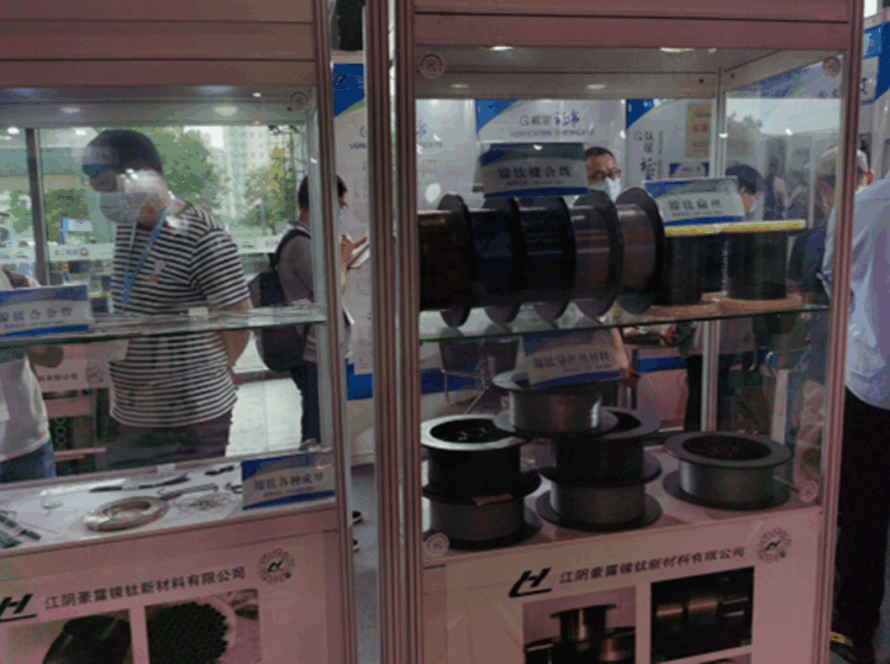
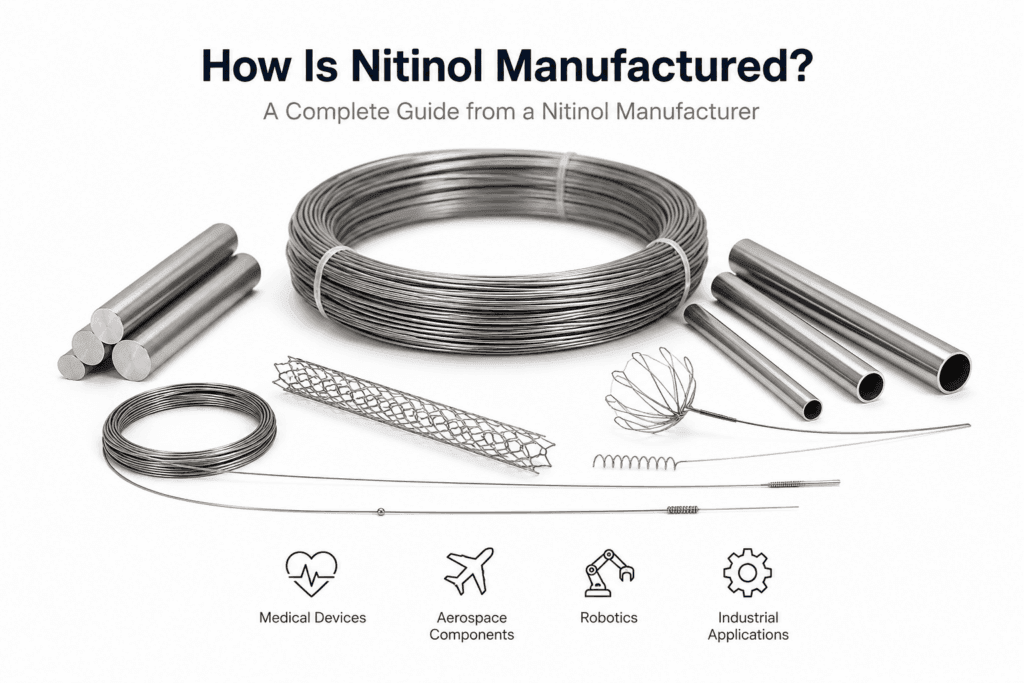
How Is Nitinol Manufactured? A Complete Guide from a Nitinol Manufacturer
Nitinol is a unique nickel-titanium alloy known for its shape memory effect and superelasticity. These properties make it an important material for medical devices, aerospace components, robotics, and industrial applications. However, producing high-quality Nitinol requires advanced manufacturing technology and strict quality control.
Many engineers and buyers ask, how is Nitinol manufactured? The answer involves several precision processes that transform raw nickel and titanium into high-performance Nitinol wire, Nitinol tube, Nitinol rod, and custom medical components.
Raw Material Preparation
The manufacturing process begins with high-purity nickel and titanium. The chemical composition must remain carefully controlled because even small variations can affect transformation temperatures and mechanical properties.
Manufacturers select premium raw materials to ensure consistent performance and reliable product quality.
Vacuum Melting
The next step involves melting the nickel and titanium under vacuum conditions. Vacuum melting reduces contamination and prevents unwanted reactions with oxygen and other gases.
This process helps achieve:
- High material purity
- Uniform chemical composition
- Improved mechanical performance
- Stable transformation temperatures
Vacuum induction melting and vacuum arc remelting often work together to produce premium Nitinol alloys.
Hot Working and Forming
After melting, the alloy forms into billets. Manufacturers then use forging, rolling, or extrusion processes to refine the material structure and prepare it for further processing.
These operations improve material uniformity and create the foundation for wire, tube, and rod production.
Wire and Tube Manufacturing
The alloy undergoes multiple drawing operations to achieve precise dimensions.
For Nitinol wire production, manufacturers gradually reduce the diameter through a series of drawing dies.
For Nitinol tube production, precision tube drawing techniques create thin-wall hypotubes with tight tolerances for medical applications.
At this stage, dimensional accuracy becomes critical because many medical devices require extremely precise specifications.
| Process Step | Description & Benefit |
|---|---|
| Heat Treatment | Controls transformation temperatures, mechanical properties, and superelastic performance of the Nitinol alloy. |
| Shape Setting Fixture | Components are secured in custom fixtures to achieve precise geometries and dimensional consistency. |
| Controlled Heating | The fixture and component are heated at carefully controlled temperatures to program the desired shape. |
| Cooling Process | After cooling, the Nitinol component permanently retains its programmed geometry and functional properties. |
| Final Performance | The finished component exhibits shape memory behavior and excellent superelastic performance. |
Surface Finish Options for Nitinol Wire
Different applications require different surface finishes for Nitinol wire. Proper surface treatment improves corrosion resistance, biocompatibility, and appearance.
Surface Finish Types and Features
| Surface Finish | Key Features | Main Applications |
|---|---|---|
| Bright Finish | Smooth and shiny metallic surface, basic protection | Industrial and general engineering |
| Pickled Finish | Removes oxide layer and surface impurities | Pre-processing for further treatment |
| Black Oxide Finish | Dark protective coating, improves corrosion resistance | Mechanical and industrial parts |
| Electropolished Finish | Ultra-smooth, clean surface with high corrosion resistance | Medical devices, implants, precision instruments |
| Medical-Grade Surface Treatment | High purity surface with strict biocompatibility control | Surgical tools, stents, guidewires |